
Filter by Letter
Tree
Size
Adaptability
Fall Color
Growth Rate
Native Habitat
Hardiness
Total results: 182


Jefferson provides a spreading umbrella of shade in a variety of site conditions. Selected as a 70 year old tree on the National Mall and introduced by the National Arboretum, Jefferson has impressed as a young tree with sturdy branching and handsome foliage.
Show moreView Detail

Colonial Spirit American Elm is an extremely hardy and adaptable shade tree with an upright vase-shaped habit of growth and a dense branching structure. it is an excellent choice for modern landscapes due to its high DED resistance and its classic American elm form.
Show moreView Detail

Selected 90 years ago, Princeton American Elm (Ulmus americana 'Princeton') has thrived on the streets of New Jersey for nearly a century forming one of the most beautiful tree plantings in the world. The most recent research from the National Arboretum ranks Princeton American Elm at...
Show moreView Detail

Everclear™ Lacebark Elm is set apart from other Lacebark Elms by its narrower proportions. Though not a columnar tree, it grows much taller than wide to an estimated 40' x 25', while other Ulmus parvifolia grow wider than high. It makes a good street tree...
Show moreView Detail

'Dynasty' Lacebark elm originated from the Natoional Arboretum's selection program, and possesses many traits which make it ideal for a multitude of landscape uses. 'Dynasty' forms a graceful, vase-shaped, spreading canopy of long, arching, and somewhat weeping branches. Leaves are two to three-inches-long, shiny, dark...
Show moreView Detail

Allée® Lacebark Elm is a vigorous shade tree that forms a gigantic vase-shaped form. The urban tolerance of Lacebark Elms is the stuff legends are made of. This elm selection is a great choice where a large shade tree is needed.
Show moreView Detail

Filling the void of a small Lacebark Elm, we now have 'Small Frye' available, which is distinguished by its small size and broad rounded crown. Covered with very dense, dark green foliage, it creates a solid dome of green. The tree also has outstanding exfoliating...
Show moreView Detail

Chindo Viburnum is a great tough, flowering evergreen for the South. It is a dense, pyramidal shrub with lustrous dark green foliage that emerge with reddish tips in the spring. The clusters of small white flowers develop into bright red berries in the fall that...
Show moreView Detail

Walter's Viburnum is a shrub or small tree native to the southeast US that is densely twiggy and upright ascending. It is evergreen to semi-evergreen with a wild and splaying habit. Its native habitat is the coastal plains in hammocks, thickets, and swamp margins. This...
Show moreView Detail

Wintergreen is more cold hardy selection of this screening plant/specimen. Withstood -8F in north Atlanta in the mid-1980s. Another exciting selection from Dr. John Ruter of University of Georgia. Shade adaptation puts it in a small class of evergreen trees.
Show moreView Detail
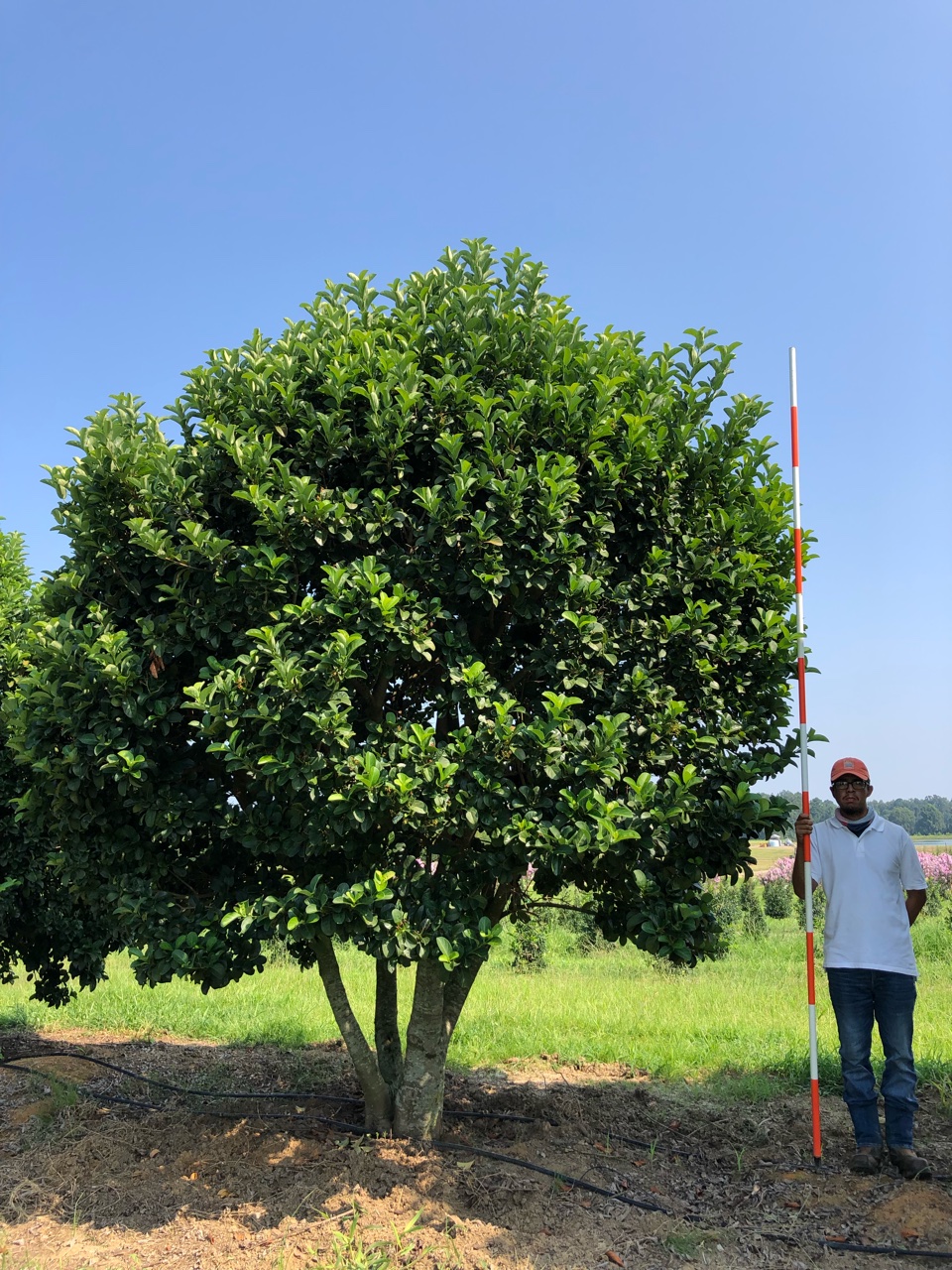
Here is a new way to provide a large sized hedge or flowering evergreen specimen tree. Dr Ruter of UGA propagated this unusually cold hardy form of Viburnum odoratissima after it survived -8F in North Atlanta. It has remained unharmed and attractive in our...
Show moreView Detail
Rusty Blackhaw Viburnum grows in dry to moist soil in full sun to partial shade slowly reaching a height and width of 10 to 20 feet. Clusters of small, white flowers mature in early spring followed by a blue drupe that matures in fall. This low maintenance...
Show moreView Detail